Introduction
Every organization generates data.
Customer transactions, website activity, mobile applications, business operations, payments, IoT devices, social media, and internal systems continuously produce large amounts of information. But raw data is not immediately useful.
Before analysts, data scientists, and business teams can use that information, it needs to be collected, cleaned, transformed, stored, and made accessible.
This is where data engineering comes in.
Data engineering focuses on building and maintaining the systems, pipelines, and infrastructure that move data from different sources into reliable and usable destinations.
If you are interested in technology, programming, databases, automation, and working with large amounts of data, data engineering can be an interesting career path to explore.
What Is Data Engineering?
Data engineering is the process of designing, building, testing, and maintaining systems that collect, transform, store, and deliver data for analysis and other business applications.
A data engineer works with data from multiple sources and creates reliable pipelines that make the data available to downstream users and systems.
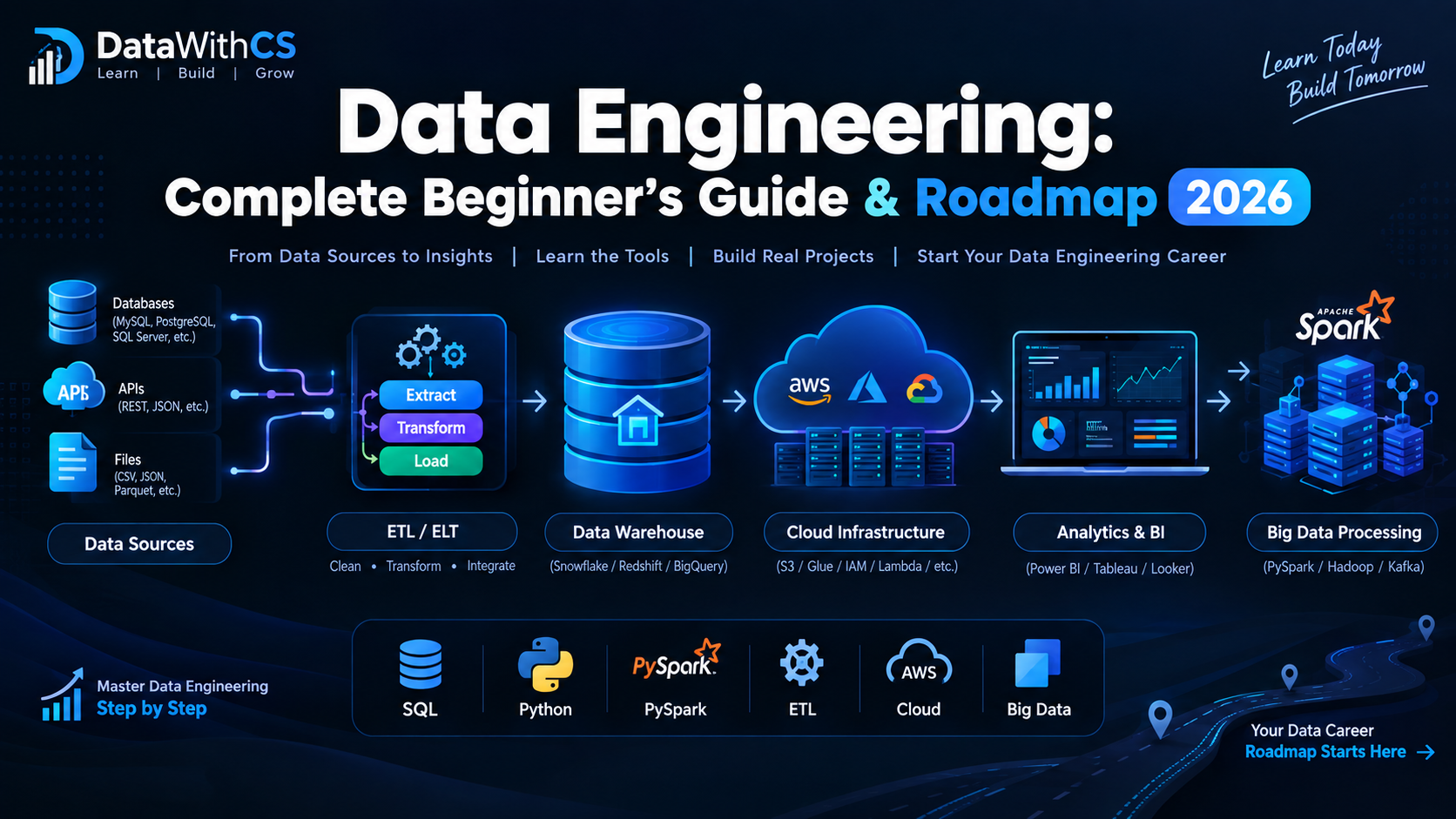
A simplified data engineering workflow looks like this:
Data Sources → Ingestion → Storage → Transformation → Data Warehouse/Lake → Analytics & Applications
For example, imagine an e-commerce company.
It may collect data from:
- Website orders
- Customer accounts
- Payment systems
- Mobile applications
- Product databases
- Marketing platforms
A data engineer can build pipelines that collect this information, validate it, transform it into useful formats, and store it in a data warehouse.
The analytics team can then use that processed data to create dashboards, reports, and business insights.
What Does a Data Engineer Do?
The exact responsibilities vary between organizations, but common data engineering activities include:
1. Building Data Pipelines
Data engineers create automated workflows that move data between systems.
For example:
MySQL → Python/ETL → Data Warehouse → Power BI
A pipeline may run every few minutes, every hour, or once per day depending on the business requirement.
2. Extracting Data
Data can come from many different sources, including:
- Relational databases
- APIs
- CSV and Excel files
- Application logs
- Cloud storage
- Streaming systems
The engineer needs to understand how to reliably collect this data.
3. Transforming Data
Raw data often contains duplicates, missing values, incorrect formats, or inconsistent information.
Transformation processes can include:
- Cleaning data
- Removing duplicates
- Standardizing values
- Joining datasets
- Aggregating records
- Converting data types
- Applying business rules
4. Storing Data
Data engineers work with different storage technologies depending on the organization's requirements.
Examples include:
- PostgreSQL
- MySQL
- SQL Server
- Data warehouses
- Data lakes
- Cloud storage
5. Monitoring Pipelines
A pipeline that works today should continue working tomorrow.
Data engineers therefore need to monitor:
- Pipeline failures
- Data quality
- Processing time
- Missing data
- Duplicate records
- Infrastructure problems
6. Improving Performance
As data volume grows, inefficient pipelines can become slow and expensive.
Data engineers optimize queries, transformations, storage, and processing systems to improve performance and scalability.
Data Engineering vs Data Analytics vs Data Science
These roles work closely together, but their primary responsibilities are different.
RolePrimary Focus
Data Analyst
Analyzing data and creating reports/dashboards
Data Engineer
Building data pipelines and data infrastructure
Data Scientist
Building statistical and machine learning models
A simplified example:
Data Engineer: Makes reliable data available.
Data Analyst: Uses that data to understand business performance.
Data Scientist: Uses data to build predictive or machine learning models.
In real organizations, these responsibilities can overlap depending on the company and team structure.
Skills Required to Become a Data Engineer
You don't need to learn every technology available in the industry.
A strong foundation is more important.
1. SQL
SQL is one of the most important skills for data engineering.
You should understand:
- SELECT
- WHERE
- GROUP BY
- ORDER BY
- JOINs
- Subqueries
- Common Table Expressions
- Window Functions
- Aggregate Functions
- Views
- Indexes
- Query optimization
You should also practice solving real-world SQL problems rather than only memorizing syntax.
2. Python
Python is widely used for data processing, automation, ETL, and data engineering workflows.
Important concepts include:
- Python fundamentals
- Functions
- Object-oriented programming
- Exception handling
- File handling
- Modules and packages
- APIs
- Working with JSON
- Data processing
- Automation
Libraries such as Pandas can also be useful for working with structured data.
3. Databases
A data engineer should understand how databases work.
Start with relational databases such as:
- PostgreSQL
- MySQL
- SQL Server
Important concepts include:
- Tables
- Primary keys
- Foreign keys
- Relationships
- Normalization
- Indexes
- Transactions
- Constraints
- Query execution
4. ETL and ELT
ETL stands for:
Extract → Transform → Load
ELT stands for:
Extract → Load → Transform
These are common approaches for moving and processing data.
Understanding the concepts is more important initially than memorizing a particular tool.
5. Data Warehousing
Data warehouses are designed to support analytical workloads.
You should understand concepts such as:
- Fact tables
- Dimension tables
- Star schema
- Snowflake schema
- Slowly Changing Dimensions
- Data marts
- Partitioning
6. Apache Spark and PySpark
When datasets become large, traditional single-machine processing may not be sufficient.
Apache Spark is a distributed data processing framework.
PySpark allows engineers to use Spark through Python.
Important concepts include:
- DataFrames
- Transformations
- Actions
- Spark SQL
- Joins
- Aggregations
- Partitioning
- Caching
- Performance optimization
7. Cloud Platforms
Modern data engineering frequently involves cloud platforms.
Common platforms include:
- Microsoft Azure
- Amazon Web Services (AWS)
- Google Cloud Platform (GCP)
You don't necessarily need to learn all three initially.
Choose one platform and build practical projects with it.
8. Version Control
Git and GitHub are important for managing code and collaborating with teams.
You should understand:
- Repositories
- Commits
- Branches
- Merging
- Pull requests
- .gitignore
9. Data Orchestration
As pipelines become more complex, organizations need systems to schedule and manage workflows.
Tools and platforms used in the industry include Apache Airflow and cloud-native orchestration services.
Data Engineering Roadmap for Beginners
If you're starting from zero, avoid trying to learn dozens of tools simultaneously.
A practical sequence is:
Step 1: Learn SQL
Build a strong SQL foundation.
Practice:
- Queries
- Joins
- CTEs
- Window functions
- Aggregations
- Query optimization
Step 2: Learn Python
Focus on programming fundamentals and data processing.
Step 3: Learn Databases
Work with PostgreSQL or MySQL and understand database design.
Step 4: Learn ETL
Build simple pipelines that extract data, transform it, and load it into a database.
Step 5: Learn Data Warehousing
Understand how analytical databases and dimensional models work.
Step 6: Learn PySpark
Move from single-machine data processing toward distributed processing concepts.
Step 7: Learn One Cloud Platform
Choose AWS, Azure, or GCP and understand its core data services.
Step 8: Learn Orchestration
Learn how to schedule, monitor, and manage data pipelines.
Step 9: Build Projects
Projects are critical because they demonstrate how you apply your knowledge.
Step 10: Prepare for Interviews
Practice:
- SQL problems
- Python problems
- Data engineering concepts
- ETL scenarios
- Data modeling
- System and pipeline design
- Project discussions
Data Engineering Project Ideas
Instead of building only small tutorial projects, try to create projects that represent real business workflows.
Project 1: E-Commerce Data Pipeline
Build a pipeline that processes:
Orders → Customers → Products → Payments
Then create analytical tables for reporting.
Project 2: Sales Data Warehouse
Create a dimensional model with fact and dimension tables.
Build analytical queries and dashboards on top of the warehouse.
Project 3: API to Database Pipeline
Extract data from a public API, validate it, transform it, and load it into PostgreSQL.
Automate the process using a scheduler.
Project 4: Large-Scale Data Processing with PySpark
Take a large dataset and process it using PySpark.
Include transformations, joins, aggregations, and performance considerations.
Project 5: End-to-End Cloud Data Pipeline
Build a complete pipeline using one cloud platform.
The architecture could look like:
Source → Ingestion → Cloud Storage → Transformation → Data Warehouse → Dashboard
Document the architecture, technologies, data flow, and design decisions.
Is Data Engineering Difficult?
Data engineering can be challenging because it combines several areas of technology.
You may need to understand:
- Programming
- SQL
- Databases
- Data architecture
- Distributed processing
- Cloud platforms
- Automation
- Data quality
However, you don't need to master everything on day one.
The best approach is to learn progressively.
Start with SQL + Python + databases, then move toward ETL, data warehousing, PySpark, cloud, and orchestration.
Is Coding Required for Data Engineering?
Yes.
Data engineering generally involves programming and scripting.
However, you don't need to become a competitive programmer to start.
The most useful programming skills are often related to:
- Processing data
- Building pipelines
- Automating repetitive tasks
- Working with APIs
- Handling files
- Writing reusable code
- Debugging applications
Strong SQL and practical Python skills can provide a solid starting point.
How Long Does It Take to Learn Data Engineering?
The timeline depends on your existing background, learning consistency, and the depth of skills you want to develop.
Someone who already knows SQL, Python, and databases can progress faster than someone starting completely from scratch.
Rather than focusing only on the number of months, focus on measurable outcomes.
For example:
Foundation → Build ETL Pipeline → Build Warehouse → Learn PySpark → Build Cloud Project → Prepare for Interviews
Your goal should be to gradually move from learning individual technologies to building complete data systems.
Career Opportunities in Data Engineering
Data engineering skills can be relevant to roles such as:
- Junior Data Engineer
- Data Engineer
- ETL Developer
- Data Engineering Analyst
- Analytics Engineer
- Cloud Data Engineer
- Big Data Engineer
Job titles and responsibilities vary between organizations, so always evaluate the actual job description rather than relying only on the title.
Final Thoughts
Data engineering is about much more than moving data from one database to another.
It involves designing reliable systems that make data available, usable, scalable, and trustworthy.
If you are starting your journey, don't try to learn every tool at once.
Build your foundation with:
SQL → Python → Databases → ETL → Data Warehousing → PySpark → Cloud → Orchestration → Projects → Interview Preparation
Most importantly, practice by building real projects.
Learning one tool after another is useful, but understanding how the complete data pipeline works is what helps you think like a data engineer.
Ready to Start Learning Data Engineering?
Explore DataWithCS to learn practical data skills through structured learning, projects, and career-focused preparation.
Start with the fundamentals. Build real pipelines. Become job-ready.