Introduction
Modern businesses generate enormous amounts of data every day.
Customer transactions, website activity, application events, payments, CRM systems, APIs, and business applications all produce data that organizations want to analyze.
But raw data usually cannot be used directly for reporting and analytics.
It needs to be collected, cleaned, transformed, and stored in a system where analysts, data scientists, and business teams can access it.
Two common approaches for handling this process are ETL and ELT.
Understanding the difference between ETL and ELT is an important foundation for anyone learning data engineering.
What Is ETL?
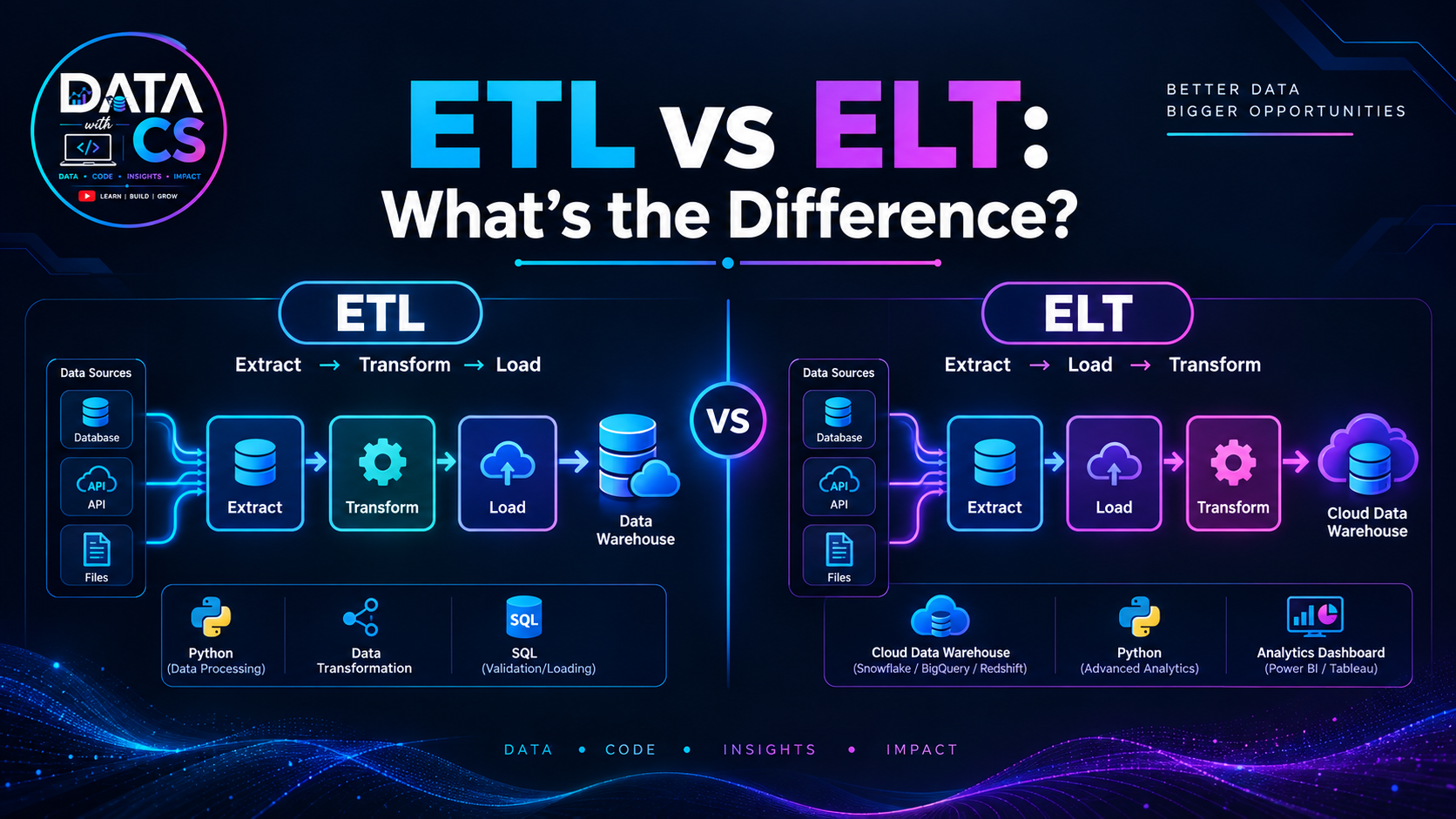
ETL stands for Extract, Transform, Load.
In an ETL pipeline, data is:
Extracted → Transformed → Loaded
The transformation happens before the data is loaded into the target system.
A simple ETL workflow looks like:
Source → Extract → Transform → Load → Data Warehouse
For example, a company might have customer data stored in MySQL.
The pipeline could:
- Extract customer records from MySQL.
- Clean and transform the data.
- Remove duplicates.
- Standardize dates and formats.
- Apply business rules.
- Load the processed data into a data warehouse.
The warehouse receives data that has already gone through the transformation process.
What Is ELT?
ELT stands for Extract, Load, Transform.
The main difference is the order of operations.
In an ELT pipeline:
Extract → Load → Transform
Instead of transforming the data before loading it, the raw or lightly processed data is first loaded into the target storage or data warehouse.
Transformations are then performed inside the destination system.
A simplified ELT architecture looks like:
Source → Extract → Load → Data Warehouse/Data Lake → Transform → Analytics
This approach has become increasingly common with modern cloud data platforms because many modern warehouses can perform large-scale transformations efficiently.
ETL vs ELT: The Main Difference
The simplest way to remember the difference is:
ETL: Transform first, then load.
ELT: Load first, then transform.
Consider this example.
Suppose you receive a CSV file containing sales information.
ETL approach
You might:
CSV → Python → Clean Data → Transform → Data Warehouse
The data is processed before it reaches the warehouse.
ELT approach
You might:
CSV → Cloud Storage/Warehouse → SQL Transformations → Analytics Tables
The raw data is loaded first and transformed afterward.
ETL vs ELT Comparison
FeatureETLELT
Full Form
Extract, Transform, Load
Extract, Load, Transform
Transformation
Before loading
After loading
Raw Data
Usually transformed before storage
Can be stored before transformation
Processing Location
External ETL system
Usually target warehouse/lake
Typical Use
Traditional data warehouses and controlled pipelines
Modern cloud data platforms
Flexibility
Can be more controlled before loading
Makes reprocessing raw data easier
Infrastructure
Often requires dedicated transformation infrastructure
Uses destination compute
Large-Scale Cloud Analytics
Can be used
Commonly used
Neither approach is universally correct. The appropriate architecture depends on the organization's requirements, data platform, security requirements, processing needs, and cost considerations.
How Does an ETL Pipeline Work?
Let's break down a typical ETL pipeline.
Step 1: Extract
The first stage collects data from source systems.
Sources can include:
- MySQL
- PostgreSQL
- SQL Server
- APIs
- CSV files
- Excel files
- Application databases
- Logs
- SaaS platforms
For example:
PostgreSQL → Extract
The pipeline retrieves the required records.
Step 2: Transform
The extracted data is processed.
Common transformations include:
- Removing duplicates
- Handling missing values
- Changing data types
- Standardizing formats
- Joining datasets
- Filtering records
- Aggregating data
- Applying business rules
For example:
A source system might store:
Ahmedabad
ahmedabad
AHMEDABAD
A transformation could standardize all values into:
Ahmedabad
Step 3: Load
The transformed data is loaded into the destination.
The destination might be:
- Data warehouse
- Database
- Data lake
- Analytics platform
The resulting flow becomes:
Source → Extract → Transform → Load → Analytics
How Does an ELT Pipeline Work?
Now consider the same process using ELT.
Step 1: Extract
Data is collected from the source.
Step 2: Load
The data is loaded into the destination platform.
It may be stored as raw or lightly processed data.
Step 3: Transform
SQL or another transformation framework is used to transform the data inside the target platform.
For example:
Raw Sales Data → Data Warehouse → SQL Transformation → Sales Analytics Table
This approach allows organizations to retain raw data and create multiple transformed datasets from the same source.
Why Has ELT Become Popular?
One major reason is the growth of modern cloud data platforms.
Modern warehouses and data platforms can provide substantial compute and storage capabilities.
Instead of moving large amounts of data into a separate transformation environment, organizations can load the data and perform transformations within their data platform.
This can simplify architecture and allow teams to work with raw data and transformation models separately.
However, ELT is not automatically better for every situation.
Architecture decisions should consider:
- Data volume
- Processing requirements
- Security
- Compliance
- Cost
- Data freshness
- Existing infrastructure
- Team expertise
Popular ETL Tools
Many tools can be used to build ETL pipelines.
Examples include:
- Apache NiFi
- Talend
- Informatica
- Pentaho
- SSIS
- Python-based ETL pipelines
- Apache Spark
The choice depends on the organization's architecture and requirements.
For learning purposes, building ETL pipelines using Python and SQL can provide a strong conceptual foundation.
Popular ELT Tools and Technologies
Modern data teams use various technologies for ELT workflows.
Examples include:
- dbt
- Snowflake
- BigQuery
- Databricks
- Amazon Redshift
- SQL-based transformation workflows
A common modern architecture may look like:
API/Database → Cloud Storage → Data Warehouse → dbt/SQL → Analytics
The specific technologies vary between organizations.
ETL vs ELT Example
Imagine an online food delivery company.
It generates:
- Customer data
- Restaurant data
- Order data
- Payment data
- Delivery data
- Rating data
ETL Architecture
The company could build:
Databases → ETL Tool → Clean & Transform → Data Warehouse → Power BI
The transformation happens before the data reaches the warehouse.
ELT Architecture
Another architecture could be:
Databases/APIs → Data Lake/Warehouse → SQL/dbt Transformations → Analytics Tables → Power BI
Raw data is loaded first and transformed afterward.
Both approaches can support analytics.
The right choice depends on the organization's technical and business requirements.
ETL vs ELT: Which One Should a Beginner Learn?
If you are learning data engineering, don't treat ETL and ELT as competing technologies.
Learn the concepts behind both.
A beginner should understand:
- How data is extracted.
- How data is loaded.
- How data is transformed.
- Where transformations happen.
- How pipelines are scheduled.
- How data quality is validated.
- How pipeline failures are handled.
- How data is stored for analytics.
Then practice both approaches.
For example:
Beginner ETL Project
CSV → Python → Transform → PostgreSQL
Beginner ELT Project
CSV → PostgreSQL → SQL Transformations → Analytics Tables
Building both projects will help you understand the architectural difference much better than memorizing definitions.
ETL, ELT and Data Engineering
ETL and ELT are only parts of the larger data engineering ecosystem.
A production data platform may contain:
Data Sources
↓
Data Ingestion
↓
Raw Storage
↓
Transformation
↓
Data Warehouse/Lakehouse
↓
Data Quality
↓
Orchestration
↓
Analytics / Data Science / Applications
A data engineer may work on several components of this architecture.
That's why learning only one ETL tool isn't enough.
Understanding the complete data flow is more important.
ETL vs ELT Interview Question
One common data engineering interview question is:
"What is the difference between ETL and ELT?"
A concise answer could be:
ETL stands for Extract, Transform, Load, where data is transformed before being loaded into the target system. ELT stands for Extract, Load, Transform, where data is loaded into the target platform first and transformed afterward. ELT is commonly used with modern cloud data platforms because transformations can be performed using the destination platform's processing capabilities.
For an interview, don't stop at the definition.
Be prepared to explain:
- A real pipeline
- Where transformations happen
- Why you selected a particular architecture
- Data quality handling
- Performance considerations
- Monitoring and failure recovery
Common Mistakes Beginners Make
Mistake 1: Memorizing ETL and ELT Definitions
Knowing the full forms isn't enough.
You should be able to draw and explain a pipeline.
Mistake 2: Learning Tools Without Understanding Architecture
Don't start with ten different ETL tools.
First understand:
Source → Ingestion → Storage → Transformation → Serving
Then learn tools that implement these components.
Mistake 3: Ignoring Data Quality
A pipeline isn't successful simply because it completed.
You should also consider:
- Missing records
- Duplicate records
- Invalid values
- Schema changes
- Incorrect data types
- Failed transformations
Mistake 4: Ignoring Monitoring
Production pipelines need monitoring and alerts.
A failed pipeline can result in incomplete dashboards and incorrect business decisions.
What Should You Learn After ETL and ELT?
Once you understand ETL and ELT, continue building your data engineering foundation.
A practical learning sequence is:
SQL
↓
Python
↓
Databases
↓
ETL & ELT
↓
Data Warehousing
↓
Data Modeling
↓
PySpark
↓
Cloud
↓
Orchestration
↓
Data Quality & Monitoring
↓
End-to-End Projects
This progression helps you move from individual concepts toward complete data engineering systems.
Final Thoughts
ETL and ELT are fundamental concepts in data engineering.
The key difference is simple:
ETL = Extract → Transform → Load
ELT = Extract → Load → Transform
But becoming a data engineer requires more than knowing these definitions.
You should understand why a particular architecture is selected, where data transformations happen, how data quality is maintained, and how pipelines are monitored and operated.
Start with simple projects using SQL and Python, then gradually explore data warehouses, dbt, PySpark, cloud platforms, and orchestration tools.
The goal isn't to memorize every data engineering tool.
The goal is to understand how reliable data moves from source systems to the people and applications that need it.
Ready to Learn Data Engineering?
Explore DataWithCS for practical learning resources, projects, and career-focused Data Engineering training.
Learn the concepts. Build the pipelines. Work with real data.